
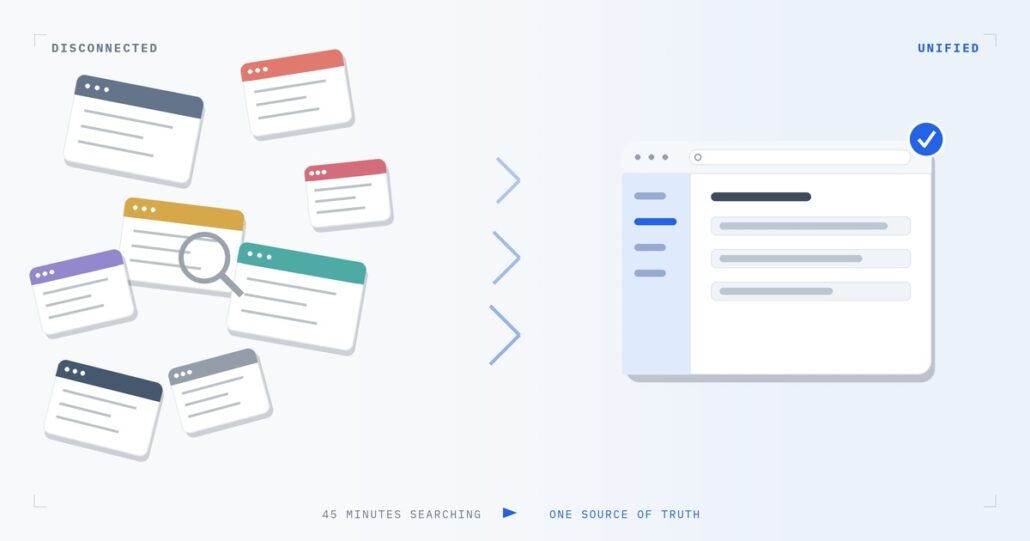
Every department has its own version of the same complaint: the tools are there, the data exists, but nobody can find it fast enough to act on it. Legal can’t locate a contract without checking seven systems. IT can’t see its own endpoints and security posture in one place. Customer service is stitching together five channels by hand. None of these look related on an org chart. All three come from the same root cause: disconnected systems.
Disconnected Systems and the Agreement Trap
Deloitte’s research puts a number on this for contracts specifically: manual, disconnected agreement processes cost the global economy close to $2 trillion a year in lost value. It’s not hard to see why. Docusign’s own data shows that without AI-powered search, it takes an average of 45 minutes to find a specific agreement, and another 1 hour and 24 minutes to locate a specific term inside it. One legal operations manager described the old process bluntly: “Before [Navigator], I used to go to seven different places to find my contracts and it would typically take around 30 minutes.” Multiply that across every renewal, every vendor negotiation, every new hire agreement, and the “trap” isn’t an exaggeration: it’s a recurring tax on the business.
The fix isn’t a faster way to search seven systems. It’s one system: a centralised, AI readable repository where agreements become structured data instead of static PDFs, and automated, no code workflows (identity verification, data capture, signature, third party app connections) replace the manual handoffs that cause the delays in the first place.
IT and Security Are Living the Same Story
On the infrastructure side, disconnected systems create the same blind spot: 58% of organisations report that their security and IT data is siloed. That’s not just an efficiency problem: it’s a risk one. Vulnerability exploitation is now the number one breach entry point (31%), and compromised endpoints were involved in half of all breaches tracked in the Verizon 2026 Data Breach Investigations Report. Meanwhile, 56% of organisations say siloed data is their single biggest obstacle to getting AI ready, according to Cloudera and Harvard Business Review Analytic Services (March 2026). You can’t prioritise what you can’t see, and you can’t govern endpoints scattered across disconnected tools with the speed today’s threat landscape demands.
Customer Experience Is Next
The same consolidation logic is playing out in customer experience. The platforms pulling ahead aren’t the ones adding another messaging channel or another point solution: they’re the ones unifying messaging, AI agents, routing and customer data into a single layer. And the AI layer specifically only performs when it’s built on that unified foundation: mature agentic AI deployments are already delivering measurable results, including $500M+ in bottom line impact from agentic workflows, $1B+ in contact centre savings, and self-service rates up to 85%. But those numbers come from organisations that solved the data fragmentation problem before layering on automation.
System of Record Before Automation
By 2028, 95% of organisations expect to be running generative AI in daily operations, and 58% are already piloting agentic AI today. That’s the context that makes this urgent: the appetite for automation and AI is already here, but automation built on top of disconnected systems just produces faster, more expensive chaos. The organisations getting real returns, in legal, in IT and security, in customer experience, did the unglamorous work first: pick one system of record, get the data into it, and automate from that clean foundation outward.
If your team recognises any of this: contracts nobody can find, IT and security data spread across five dashboards, a customer experience stitched together by hand, that’s the place to start. Not with another automation project, but with the question: do we actually have one system of record, or seven?
Sources: Docusign, Contract Management Trends (2022); Deloitte & Docusign, Digital Agreement Management Study (2024); Docusign Maestro Datasheet (21 Oct 2024); Docusign IAM + Navigator Overview; Verizon 2026 DBIR; Cloudera/Harvard Business Review Analytic Services (March 2026); Think Tank ecosystem deck (August 2026).
