
Autonomous Endpoint Management: Why IT Teams Are Moving Beyond Manual Fixes
Most IT teams know the feeling. A device falls out of compliance. A patch gets missed. An incident sits unresolved for hours. Nobody notices until a user complains. This isn’t a resourcing problem. It’s a visibility and automation problem, and it’s exactly what autonomous endpoint management solves.
The Pressure IT Teams Are Under
The numbers behind this shift are hard to ignore. Ivanti’s own research shows 62% of IT professionals feel overwhelmed by day to day operations. Nearly one in four say a colleague has resigned due to burnout. A quarter of IT professionals also say they lack an effective tool to proactively fix end user issues, and that gap has widened over the past year.
The threat landscape has sped up too. New vulnerabilities appear daily. Patches roll out constantly. Attackers can weaponise a critical exploit within hours, sometimes before a patch even exists. Manual, ticket by ticket endpoint management can’t keep pace with that speed.
What Autonomous Endpoint Management Actually Does
Autonomous Endpoint Management, or AEM, unifies endpoint management, security, and digital employee experience into one AI powered system. Instead of waiting for a user to log a ticket, AEM continuously monitors every device, prioritises risk, and fixes issues before they turn into incidents. Gartner calls this a transformative, intelligence infused approach that improves speed, compliance, and user experience.
In practice, this looks like:
- Continuous discovery and verification. AEM tracks every endpoint against a single, trusted system of record, closing the gaps that fragmented tools and manual reconciliation leave behind.
- Risk based, automated patching. Instead of patching everything on the same schedule, AEM prioritises the vulnerabilities that matter most.
- Self-healing operations. The system fixes many issues automatically, often before a user notices anything went wrong.
- Lifecycle visibility. AEM tracks devices from acquisition through retirement, so teams avoid overprovisioning and unnecessary refresh spend.
The result: a shift from reactive firefighting to a proactive, closed loop process. Discover, act, verify, remediate.
Built on the Ivanti Neurons Platform
AEM runs on the Ivanti Neurons platform, the shared infrastructure behind Ivanti’s Exposure Management, ITSM, and Network Security tools too. Ivanti recommends AEM as the starting point for most organisations. It turns visibility into action quickly and cuts manual work through automation, bots, and self-healing right away. From there, teams can expand into other domains on the same platform, without adding new tools or fragmenting governance.
Ivanti keeps building on this foundation. In July 2026, the company announced new AEM capabilities, including predictive remediation. This gives IT and security teams governed, automated workflows with admin control, so they can act on trusted data, cut operational risk, and remediate issues faster ahead of compliance deadlines.
Proof at Scale
Ivanti didn’t just build AEM for customers. The company deployed it internally too, as its own “Customer Zero.” Ivanti now runs Autonomous Endpoint Management across a distributed, largely remote workforce of more than 10,000 endpoints. The rollout started with a single configuration management database to unify endpoint data. From there, Ivanti layered in real time telemetry and digital experience monitoring, so many issues now get resolved automatically, often before anyone notices.
The approach has earned recognition beyond Ivanti’s own walls too. Cloud Computing Magazine named Ivanti’s AEM solution a 2026 Product of the Year winner, for helping organisations move past reactive, fragmented tooling toward continuous, trusted autonomy at scale.
What This Means for Enterprise IT Teams
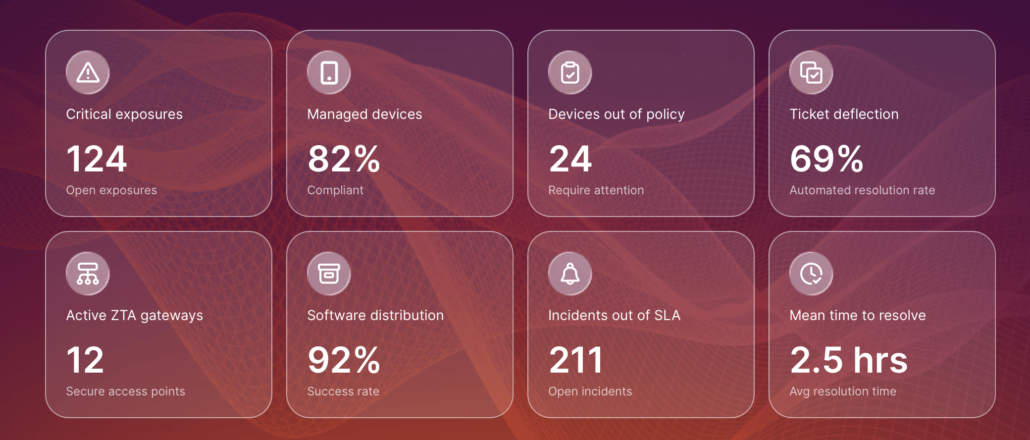
For CIOs and IT leaders running large, complex environments, the case for AEM comes down to a few practical outcomes. Fewer open exposures. Faster incident resolution. Higher compliance rates. Less time spent on manual ticket handling. IT budgets stretch further too, since lifecycle visibility cuts both unnecessary purchases and hidden maintenance costs.
As an Ivanti partner, Think Tank helps enterprise IT teams across South Africa implement Autonomous Endpoint Management in a way that fits their existing environment and priorities. Some teams start with visibility and compliance. Others move straight into automated remediation.
If your team still manages endpoints one ticket at a time, it’s worth seeing what a continuously verified, self-healing approach could look like instead.
