
AI in IT operations has moved well past the pilot stage. According to Ivanti’s 2026 AI Maturity Report, 56% of organisations now run AI broadly across multiple workflows or at business-critical scale, and only 2% report no AI use at all.
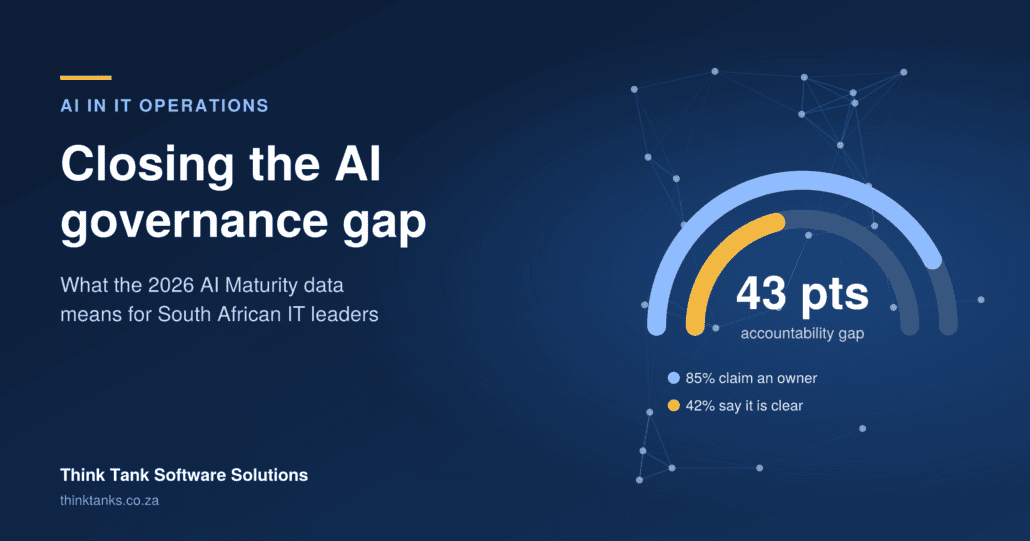
But one finding stands out above the rest. 85% of IT professionals say every AI agent and workflow in their organisation has a named, accountable owner. Only 42% say that accountability is actually clear.
That 43-point gap is where AI value is won or lost. For South African IT leaders weighing how fast to scale automation, it is also the most useful place to start.
Maturity pays off, and the gap is wide
The organisations getting the most from AI are not simply using more of it. They have built the structure underneath it, and the results are measurably different.
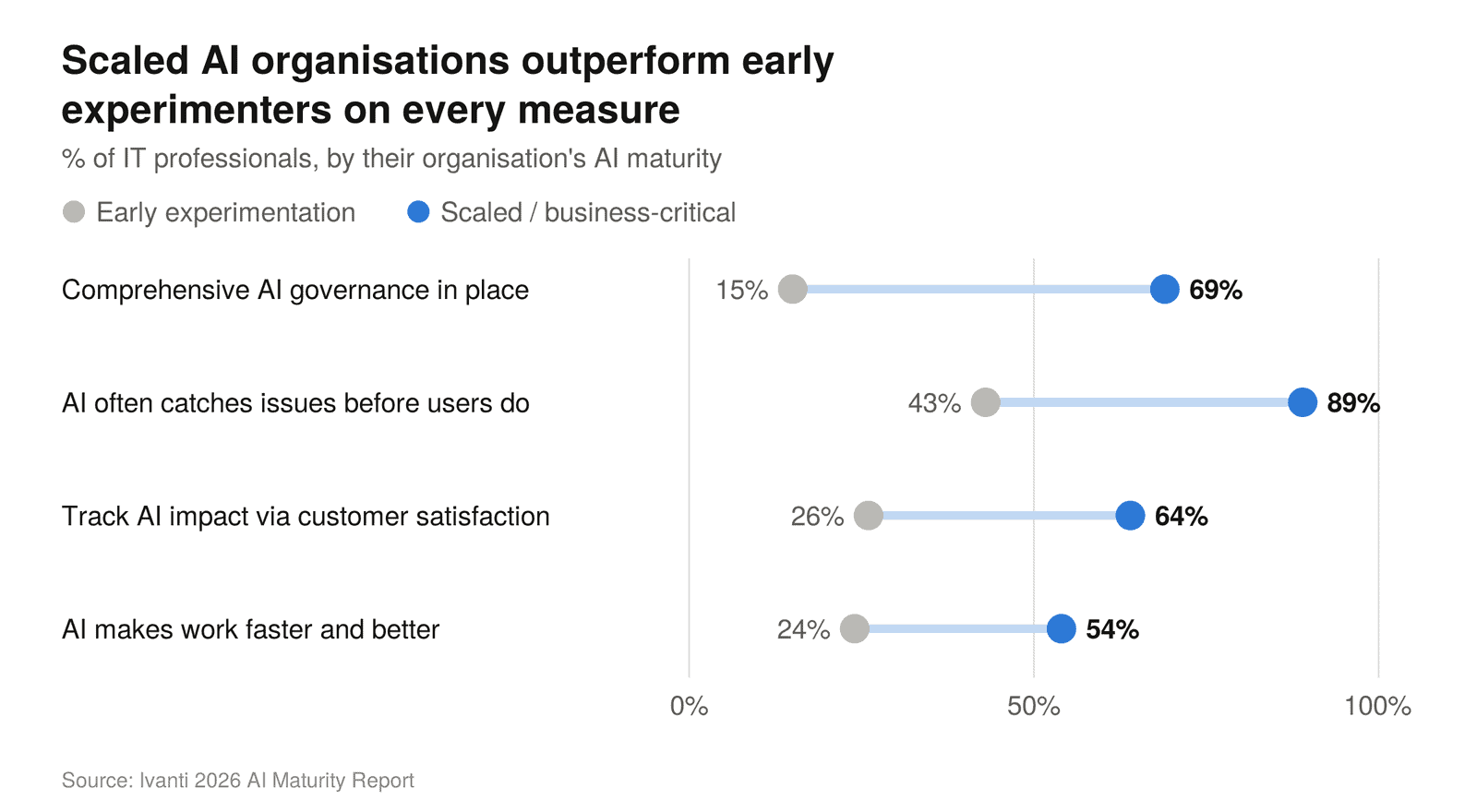
The benefits extend to people too. IT professionals at the most advanced level of AI use save an average of 6 hours a week, double the least mature users. And 91% of scaled organisations have created dedicated AI roles or teams, compared to 72% across all respondents.
Deployment is outpacing governance
Most IT organisations have the basics on paper. The report found that 65% have AI risk review processes, 59% have policies for approving new AI solutions, 58% have acceptable use policies and 49% have AI oversight bodies.
The problem is what happens in practice:
- Only 24% of employees say AI policies are followed very consistently in day-to-day work.
- 68% of IT professionals have personally seen AI produce hallucinations with potential operational impact. 16% saw those errors cause real issues before anyone caught them.
- Leaders are nearly twice as likely as other employees to keep their AI use secret (42% vs 23%).
- Regulated industries such as government, healthcare and education show the highest rates of unsanctioned AI tool use.
Governance is now the most cited barrier to faster AI deployment. 27% of IT professionals name governance, security or compliance as their biggest obstacle, ahead of skills shortages (20%), technology limitations (17%) and data challenges (14%).
That matters because the pace is not slowing. IT teams expect AI to automate nearly half (46%) of their operations within 18 months. Scaling automation on top of unclear ownership multiplies risk at the same rate it multiplies output.
Why this matters for South African enterprises
The survey covered the US, UK, France, Germany, Australia and Japan, not South Africa. But the pressures it describes are, if anything, sharper here.
Accountability is already a legal expectation. POPIA places responsibility for how personal information is processed squarely on the organisation. An AI agent that touches employee or customer data without a clear owner is a compliance exposure, not just an operational one.
Our largest employers are in regulated sectors. Financial services, government, healthcare and education make up a big share of South Africa’s enterprise landscape. These are exactly the sectors the report flags for the highest unsanctioned AI use. When approval processes are slow, people find workarounds, and those workarounds sit outside IT’s line of sight.
Lean IT teams feel the upside most. Many local IT departments support large, distributed workforces with limited headcount and scarce specialist skills. Automating high-volume L1 and L2 support and endpoint operations, where the report shows AI agents are most concentrated, frees those teams for work that needs human judgement. But only if the guardrails are in place first.
Four steps to close the gap
- Set trust thresholds before you scale
Decide upfront which actions AI can take on its own and which need a human in the loop. The report gives a practical model: let AI autonomously restart failed services or apply routine patches, but require human validation for system-wide configuration changes and high-severity incidents. 55% of IT professionals already say they would never let AI handle a high-severity incident without human review.
- Make ownership real, not nominal
Every AI agent and automated workflow needs a named owner and a defined escalation path, set before something goes wrong. The aim is to move from the 85% who claim ownership exists to a team that can actually tell you who is accountable for each workflow.
- Build governance into the platform
Policies that rely on people remembering to follow them will be followed 24% of the time. Mature organisations embed trust thresholds, approval requirements and escalation paths into the platform itself, so they are enforced automatically. Consolidating onto a unified platform also gives you one system of record for what your AI is doing, which is what makes it auditable.
This is the thinking behind autonomous endpoint management (AEM): AI that does not just flag an issue but resolves it, within boundaries IT has defined.
- Start with what you already have
You do not need a major new AI programme to see results. The report notes that many IT teams are sitting on untapped capacity in tools they already own. Expanding automation that is already working is faster, lower risk and often more impactful than launching new pilots. Pair it with structured upskilling: intent to upskill climbs from 37% among basic AI users to 86% among advanced ones, so the appetite is there.
The window for measured action is narrowing
The question is no longer whether AI will reshape IT operations. It already is. The real question is whether your organisation scales it on a foundation that is secure, auditable and clearly owned, or plays catch-up with governance after the fact.
As an Ivanti Premier Partner, Think Tank helps South African enterprises put that foundation in place, from AI-driven service management to autonomous endpoint management with governance built in. If you want to understand where your organisation sits on the maturity curve and what to tackle first, get in touch with our team.
Sources
- Ivanti, Scaling AI in IT Operations: The Path to Maturity in 2026. Survey of 3,900 employees (1,500 IT professionals, 2,400 office workers) at organisations with 500+ staff across six countries, February to March 2026.
